
The artist offers a track-by-track of his fourth full-length, an album that’s a product of “Giving himself permission”
———————————————————————————————
Four-ish years ago, I was in the backseat of my parents’ car, riding through the desert after my brother’s wedding in Zion, when I saw an Instagram post from an artist named Arlo Indigo saying he missed house shows and asking if anyone was down to make something happen.
As a New Yorker with a living room of a certain size (bigger than a closet) with roommates and neighbors of a certain tolerance (unusually high), I was essentially obligated to respond.
I shot Jeremiah (Arlo’s given/offstage name) a DM, we added a charity component and that became Strong Little Songs, a bi-monthly show series with a stripped-down setup, through which we’ve raised thousands of dollars for charities including Art Start, Make the Road, Palestine Children’s Relief Fund, Razom for Ukraine, UNICEF, The Trevor Project, The Ali Forney Center, Food Bank for NYC, Sweet Relief Musicians Fund and others (there is no shortage of organizations in desperate need of our help).
Beyond the 20-something (and counting) cozy events featuring good music, good causes, too much wine and countless vegan cookies, what these evenings have also offered me is the opportunity to watch art (and artist) evolve in real time.
During our pre-show chit-chat, as Jeremiah sets up the sound system he’s lugged from Bushwick between our plants and under an old roommate’s Bollywood poster—a piece of decor that precedes, and will likely outlast, every resident present—I get a brief life update. The circumstances surrounding, and influencing, his art. And during the shows themselves, I witness the emotional output. Jeremiah has opened every edition of Strong Little Songs, and over the last four years, I’ve seen his songs and stories be debuted and developed. Through the painful events of his personal life; within an increasingly shocking and violent world.
As a co-host, a friend and a fan, it’s been a big privilege to be present for the process and the progression of this music. And now I’m just so thrilled that the final product—the first record in four years, about as long as we’ve been working together—is officially available for listening beyond the four walls of my Crown Heights apartment.
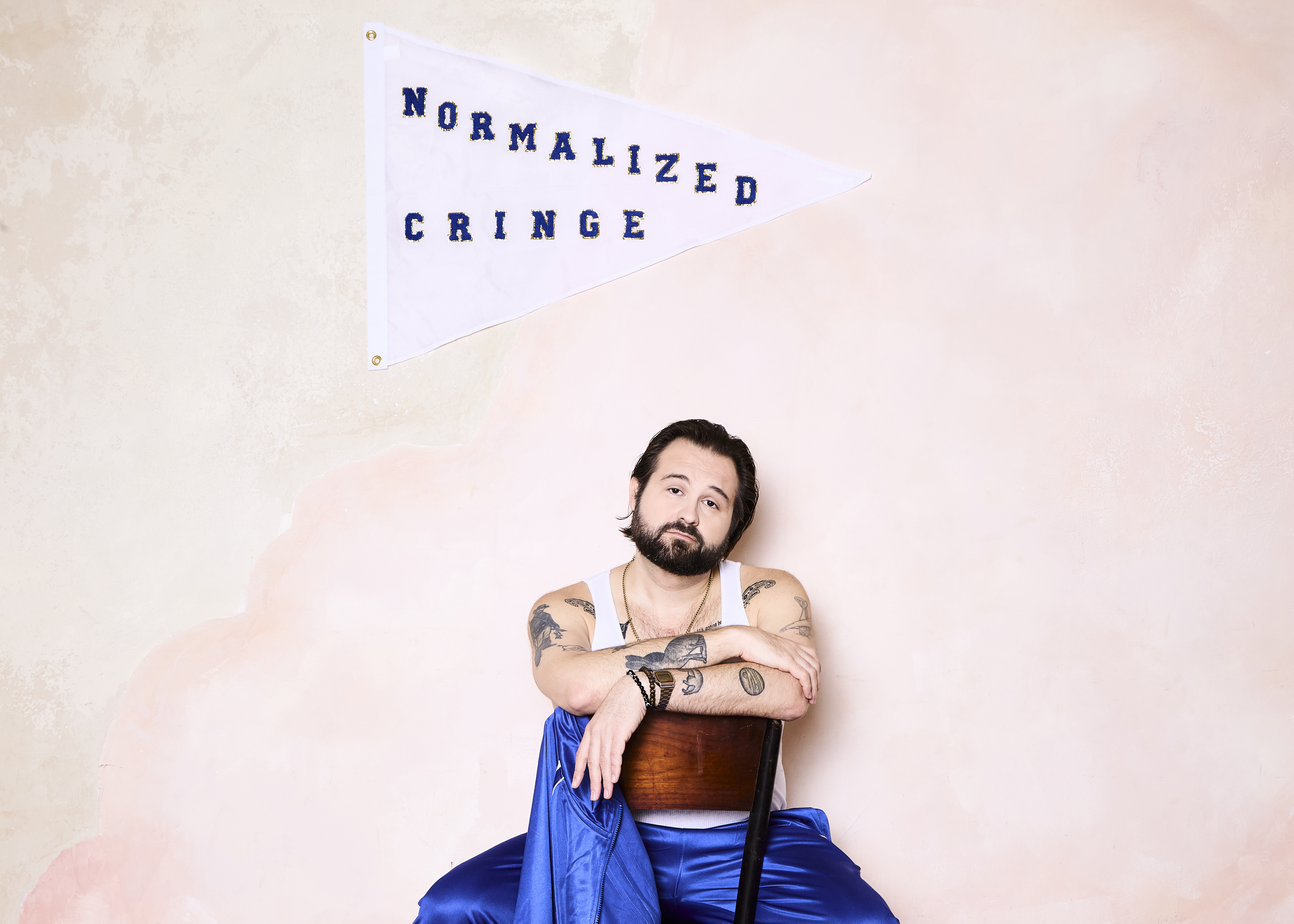
From Eastern Parkway to the World Wide Web, from Arlo Indigo, it’s Normalized Cringe.
Normalized Cringe dropped last week, and with the release, Jeremiah offered a few thoughts on the making of this record and, in writing it it, the gift that he gave to himself.
“My fourth full-length record of this project, Normalized Cringe is an album about giving myself certain permissions. Permission to really speak my mind upon what was going on around me, permission to embrace some of the folkier music I have historically felt mixed emotions about enjoying and permission to try and see how ‘perfectly imperfect’ one can make recordings in the spirit of chasing that fleeting quality that is ‘realness.’”
To commemorate the release, I called on Jeremiah to speak to the tracks that have been heard and honed in my living room. To share a few of the stories he’s told on Tuesday nights over the years, sitting on an old yellow chair dragged over from the kitchen table and picking on his guitar. Happily, he obliged. From the personal to the political—and the anxieties and insecurities that unite us all—here’s a breakdown of the ten songs on Normalized Cringe.
Normalized Cringe —TRACK BY TRACK:
“Cool Off“
“This is admittedly a tune about the melancholy that has surrounded us all in the past few years post global pandemic. There’s this feeling of ‘what’s next’? And ‘is what’s next going to be good or bad?’ looming over all of our heads in our daily lives whether you are into the
news or not. The future isn’t as bright as it used to be and my line ‘The years turn to teeth and devour our pride’ was penned to talk about how we have all been feeling similar time dilation as we quickly slog into the future.”
“Power”
“I wanted to be careful while writing this song because this concept and who does and doesn’t possess it is a classic debate. This is the flagship single of the record and where the idea of ‘normalized cringe’ came from. It’s a song about how the industry has changed every musician into a ‘content’ creator and how therefore plenty of musicians (myself included) feel like we can’t keep up (or stay inspired) with the labor the attention economy has installed and
how that will inevitably make a lot of musicians feel like they’re just going to be forced out of an artist pursuit they love.”
“Drunk & Worthless”
“This song was written during a time I was medicating with the oldest anxiety medication there is while in my mind knowing that the jig was going to be up and this wasn’t going to be sustainable. They say self-awareness can be a person’s greatest strength as well as a weakness, so when I wrote the line ‘I’ve got a friend in the bottle in front of me and no future, just my past,’ I meant it.”
“You’re My Morning”
“This is a song about trying to love yourself while knowing your heavy
feelings are negatively affecting the people around you. It’s meant to be a love song written by someone who isn’t sure what love is, but longs to feel secure when their spirit feels cold.”
“Digital Slum”
“Political songs are hard because everything has gotten so bad for so many people, that the act of even commenting on it feels like cheap low-hanging fruit. This song came out of me after the Oct. 7 attacks and in my heart I knew that this would lead to the exact situation we have today, ongoing wars and open genocide all of these quick years later. The lines ‘We share a mean fate waiting for the bombs, living in a digital slum, howling with hearts beating heavy and so withdrawn’ is a sentiment I felt then and still feel today as tech and authoritarianism does it’s best to keep us at each other’s throats and geographically isolated with harsh economies so they can strip mine our planet and culture to the point no regulation can touch them.”
“The Next Day”
“This is a song that was actually written in a different project that didn’t end up taking off and I didn’t want to lose the song. It’s meant to be kind of an anthem for self-empowerment in a world that looks at us all as numbers on a page and where our personal identities fall as a result of that. ‘We learned to sign our own graves while our names are taken away’ is about how we give up ourselves to work ourselves to death for a society that doesn’t return any of said labor.”
“You Can’t Love Someone Based On What You Get Back“
“This one has a lengthy title because any form of shortening it changes the context of the message more than I am comfortable with broadcasting. It’s a song about making sure you’re being good to the folks that care about you. Our hyper-capitalist society makes everything we do down to the favors we do for each other transactional and this tune was an attempt to remind myself of that fact.”
“American Survivor“
“This is my ‘capital P’ protest song. I wrote it all the way back in 2024 and now after we all found it laid bare that no matter who is in charge of the executive branch of America, ‘we’ allow certain allies carte blanche power to impose their will in any way they see fit
whether or not it aligns with what was left of ‘America’s moral superiority.’ I usually introduce the song live as ‘a song for anyone who’s tired of unprecedented times’ and that statement sticks. ‘I
don’t like gettin’ tied up, with which colored tie said what, I just want this work day done to get a beer with my friends’ is a statement that describes me and everyone I know.”
“More Down Than Townes“
“This is a line that I thought was pretty clever when I wrote it and the
song is about my first and only year trying mood-stabilizing medications. It was the first time I felt my mood artificially stabilized but that didn’t make me feel any happier. It also turns out I was
allergic to the medication altogether and spent a weird eight or nine months feeling strange that I will never get back.”
“There’s Just No Way Of Knowin’”
“This song is probably the closest to my heart because it
came out of me all at once in my Mom’s kitchen in Alaska about a year and a half before she lost her battle to cancer. At the time we all knew we were living on borrowed time as a family and our entire lives were gonna change but the inevitable outcome was too much to bear. To
this day I have family that would like me to go back to living in a place that’s never felt like home to me and to this day I still have trouble navigating it.”
—
Come out to hear these songs live and get collectively cringey at Arlo Indigo’s album-release party featuring performances by Parks Department, Grace Corsi and Dustin Lowman — June 3rd at Arlene’s Grocery. (A venue that is, I must admit, slightly better than my living room.) Grab your tix here.
———————————————————————————————
Follow Arlo Indigo at @arloindigo, grab music on bandcamp and add the songs to your Spotify playlists now!
Feature image (provided by the artist): Michelle LoBianco
Leave a Reply